
Contents
- 🎵 Origins & History
- ⚙️ How It Works
- 📊 Key Facts & Numbers
- 👥 Key People & Organizations
- 🌍 Cultural Impact & Influence
- ⚡ Current State & Latest Developments
- 🤔 Controversies & Debates
- 🔮 Future Outlook & Predictions
- 💡 Practical Applications
- 📚 Related Topics & Deeper Reading
- Frequently Asked Questions
- References
- Related Topics
Overview
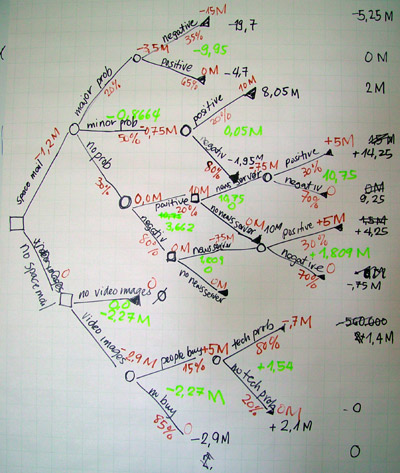
Decision tree analysis is a decision support recursive partitioning structure that uses a tree-like model of decisions and their possible consequences, including chance event outcomes, resource costs, and utility. It is one way to display an algorithm that only contains conditional control statements. Decision trees are commonly used in operations research, specifically in decision analysis, to help identify a strategy most likely to reach a goal, but are also a popular tool in machine learning. The concept of decision trees has been around for decades. Decision trees can handle both categorical and numerical data, and are particularly useful when the data is complex and nonlinear. Decision trees can be used for both supervised and unsupervised learning tasks.
🎵 Origins & History
Decision tree analysis has its roots in the concept of decision trees, which has been around for decades. Decision trees can handle both categorical and numerical data, and are particularly useful when the data is complex and nonlinear. Decision trees can be used for both supervised and unsupervised learning tasks. Decision trees are commonly used in operations research and machine learning.
⚙️ How It Works
Decision tree analysis works by recursively partitioning the data into smaller subsets based on the values of the input features. Each node in the tree represents a decision or a test, and the branches represent the possible outcomes of that decision. The leaves of the tree represent the predicted class labels or target values. Decision trees can be used to predict customer churn, recommend products, and optimize supply chain management.
📊 Key Facts & Numbers
Some key facts and numbers about decision tree analysis include: decision trees can handle both categorical and numerical data, decision trees can be used for both supervised and unsupervised learning tasks. Decision trees are particularly useful when the data is complex and nonlinear.
👥 Key People & Organizations
Some key people and organizations involved in decision tree analysis include researchers and developers in the field of machine learning and operations research. Decision trees are used by various organizations to make informed decisions.
🌍 Cultural Impact & Influence
Decision tree analysis has had a significant cultural impact and influence on the field of machine learning and operations research. Decision trees have been used in a wide range of applications.
⚡ Current State & Latest Developments
The current state of decision tree analysis is one of ongoing development and innovation. New algorithms and techniques are being developed to improve the accuracy and efficiency of decision trees.
🤔 Controversies & Debates
Some controversies and debates surrounding decision tree analysis include the issue of overfitting, which can occur when the decision tree is too complex and fits the training data too closely. Another controversy is the issue of interpretability, which can be a challenge when working with complex decision trees.
🔮 Future Outlook & Predictions
The future outlook for decision tree analysis is one of continued growth and development. As the amount of data available continues to increase, decision trees are likely to become even more widely used and effective.
💡 Practical Applications
Some practical applications of decision tree analysis include predicting customer churn, recommending products, and optimizing supply chain management. Decision trees can be used in a wide range of industries.
Key Facts
- Category
- technology
- Type
- concept
Frequently Asked Questions
What is decision tree analysis?
Decision tree analysis is a decision support recursive partitioning structure that uses a tree-like model of decisions and their possible consequences.